Talk From zero to hero: experiences from a social scientist turned rogue
Abstract & bio
The world of software development is generally associated with technical skills specific to computer science and engineering. It requires a set of fundamentals that social scientists usually do not possess, their use of software being limited to either using GUIs or at best using adapted script files. The current talk describes the road from zero knowledge in programming to a current collection of useful software, using an array of languages such as R, C, Javascript / Typescript and integration frameworks like Electron under Node.js, to create user friendly user interfaces for data collection and analysis.
Bio. Adrian teaches statistics and research methdology at the Department of Sociology, University of Bucharest. He is also the Director of RODA - the Romanian Social Science Data Archive, having been involved in creating software tools for documenting survey datasets. An active R developer, authoring multiple packages, he is now focused on creating graphical user interfaces using Electron.js under Node.
Talk First Steps in Open Source: Small Contributions, Big Impact
Abstract & bio
Identifying and contributing to open source projects with only one maintainer or low activity can have a significant impact. Discussion on how small fixes and contributions to the projects you already use can make a big difference, both for the project and for your development as a engineer. Drawing from my personal experiences, I’ll highlight the value of starting small and how these contributions can lead to deeper involvement in the open source community.
Bio. I'm a tech enthusiast, LLVM contributor, and currently a student at the Technical University of Cluj-Napoca. I love diving into Linux, customizing software, modding devices, and exploring new tech. Outside of tech, I enjoy chess, gaming, and dabbling in poetry, drawing, and photography.
Talk Open Telemetry: What? Why? How? - incl. data visualization using Grafana
Abstract & bio
In this presentation, you will learn what Open Telemetry is, why is it needed in the first place, how you can instrument your software to produce Open Telemetry data and as a bonus, how to view this data in a data visualization tool such as Grafana. Open Telemetry is a CNCF project (https://www.cncf.io/projects/opentelemetry/) and represents an industry-standard in the observability space. Grafana Labs (author of Grafana product) is a CNCF platinum project sponsor, and provides enterprise grade data visualization and data querying products (such as Grafana, Loki, Tempo, etc.)
Bio. Alexandru is a software engineer who has previously worked at Ubisoft (QA/QC engineer) and Intel (Embedded Processing engineer), and is currently working at Microsoft for the past 3.5 years.
You can find more about Alexandru on:
1. LinkedIn: https://www.linkedin.com/in/olariu-alexandru/
2. GitHub: https://github.com/arolariu
3. Personal Page: https://arolariu.ro
Talk Tock - a secure embedded operating system framework written in Rust
Abstract & bio
An overview of Tock, an embedded operating system, and what it means to implement an operating system fully in Rust.
Bio. Alexandru Radovici is an Associate Professor at the Politehnica University in Bucharest, Romania, where he has been using Rust to teach for a few years. Alexandru is also one of the maintainers of the Tock embedded operating system, written fully in Rust.
Talk Computing the "social": opportunities, challenges and where open source stands
Abstract & bio
We take a look into how we can measure the impact of open source from a social and philosophical perspective.
Bio. Alina is a PhD candidate in Cognitive Science and Language (Philosophy area) at the Autonomous University of Barcelona. Before adventuring into analysing technology and its impacts in society from a philosophical and pragmatic perspective, Alina worked and contributed to open source projects as Mozilla, developed various open source products (for universities, publishing houses and community programs), and worked in EdTech initiatives (teaching, curriculum design and mentoring).
Talk dexonline – free software or open source philology?
Abstract & bio
(talk will be delivered in Romanian) In today's technological world we tend to give a lot of credit to code writing, and also tend to forget that it is just a tool to help us achieve our goals. We all know what a dictionary looks like without the intervention of a computer scientist (we all see a paper dictionary), but have you ever wondered what an online dictionary would look like if it is crafted by the programmers only, without the philologist's contribution? Without the (free, open!) input of science... e.g. mathematics, physics or, to take our case, linguistics/lexicography, let alone open source? We not only want to give credit to anyone involved, but also we are convinced that collaboration between the specialist and the computer scientist (say interdisciplinarity where possible) is essential to the evolution/openness of society, especially the digital one.
Bio. Anca is a lecturer at the Faculty of Letters, "Dunărea de Jos" University of Galați and member of dexonline NGO. PhD in Aesthetics and Philology (2013) at the Université Paris Ouest Nanterre La Défense, with the thesis: La Question de la nomination dans l'œuvre de Maurice Blanchot. Recent publications: Le Livre, tours et détours, Casa Cărții de Știința, Cluj-Napoca, 2022; Maurice Blanchot : pour une littérature (im)possible, Editura Universității din București, 2021.
Talk AI Tools for Education: Multiple-Choice Question Generation
Abstract & bio
This talk explores an open-source project focused on using AI and NLP to automate multiple-choice question generation for reading comprehension. The presentation will showcase a full pipeline using LLMs that extracts context, selects answers, generates questions, and creates multiple answer choices. The project’s goal is to enhance educational tools by providing scalable, automated solutions for creating high-quality assessments, with applications in both academia and open science initiatives.
Bio. Andreea is a PhD student specializing in Natural Language Processing with a focus on educational applications and open science. With a strong background in AI-driven educational tools, her research explores innovative methods to enhance learning experiences through automatic methods.
Talk Wikimedia: where every single person on the planet is given free access to the sum of all human knowledge.
Abstract & bio
A (short) introduction to Wikimedia, a community where opendata, opencontent and opensource all work together to provide the essential infrastructure of the ecosystem of free knowledge. We'll discuss how openness allows anyone who shares our vision to join us and how you can help during your normal work.
Bio. Long time Wikimedian & software engineer, occasional contributor to other open-source projects
Workshop WebScraping using Scrapy
Abstract & bio
In my presentation, I'll introduce Scrapy, a Python framework for web scraping. I will also demonstrate how to clone a project from Git and create two spiders: one for static and one for dynamic websites.
Bio. Junior WebScraping Developer and contributor to other open-source projects
Workshop Git Good - An essential guide to git
Abstract & bio
Level up your git game - whether you’re just starting out or have been using git for a while, this workshop is your chance to sharpen those skills and tackle the trickiest parts of version control. In this session we will dive deep into the basics and some tricks to increase your productivity while using git. By the end of this session, you’ll have a solid foundation in Git, enabling you to manage your commits.
Bio. I’m a full stack engineer and trainer passionate about empowering developers to write robust, bug-free code. I specialize in building delightful developer tools that enhance productivity and ease application deployment. A strong advocate for best practices in cloud and backend development, I frequently speak about technology and share insights with the community. When I am not elbow-deep in writing code, I am probably nerding around about linux essentials and git.
Talk OSS Licenses
Abstract & bio
A presentation on open-source software licenses, exploring popular types like MIT, Apache, and GNU. We'll dive into their key features, pros and cons, and how to choose the right license for your project.
Bio. Experienced DevOps with over 20 years of expertise in driving large-scale cloud infrastructure and on-premises solutions across Telecom, Financial, and Real Estate sectors. Proven track record in implementing cutting-edge DevOps transformations, optimizing AWS environments, and leading high-performance teams to deliver scalable solutions in dynamic, fast-paced environments.
Workshop Docker on Servers
Abstract & bio
A fully hands-on Docker workshop with no presentations, guiding participants through the entire process—from setting up Docker by searching for the installation procedure to deploying images and beyond. The focus is on real-world, practical experience.
Bio. Experienced DevOps with over 20 years of expertise in driving large-scale cloud infrastructure and on-premises solutions across Telecom, Financial, and Real Estate sectors. Proven track record in implementing cutting-edge DevOps transformations, optimizing AWS environments, and leading high-performance teams to deliver scalable solutions in dynamic, fast-paced environments.
Talk OpenSIPS at the confluence of Open Source and VoIP worlds
Abstract & bio
The presentation will approach the particularities of Open Source usage in the VoIP and telecom worlds. By nature, the VoIP systems have a realtime and resource consuming profile, while the telecom world comes with high compliance standards and resilience factors. So how Open Source can fit into such demanding B2B environment. And how OpenSIPS project is an conclusive example of VoIP/telecom worlds embracing Open Source.
Bio. Bogdan-Andrei Iancu is the founder and core developer of the OpenSIPS Open Source Project. With 25 of years of experience in the VoIP area, Bogdan got in touch with VoIP/SIP as researcher at Fraunhofer Fokus Institute, later opting for being a player in the Open Source arena with the OpenSIPS project, one of the most used Open Source SIP Server in the world. Beside the project related activities, Bogdan is also CEO of SIPhub, a company providing commercial services and products around the OpenSIPS project.
Talk Right to repair - a new buzzword or....?
Abstract & bio
A new directive adopted by the EU in 2024 has come with an old/new buzzword - the right to repair. The presentation will focus on what are the new obligations, when they will enter into force and for who it might be helpful.
Bio. Executive Director of Association for Technology and Internet - ApTI, the only digital rights organisation in Romania. Bogdan has a legal background, a passion for technology and an experience of over 20 years in Law and Technology.
Talk Continuations: What Have They Ever Done for Us?
Abstract & bio
Surveys and experiments in economics involve stateful interactions: participants receive different messages based on earlier answers, choices, and performance, or trade across many rounds with other participants. In the design of Congame, a platform for running such economic studies, we decided to use delimited continuations to manage the common flow of participants through a study. In this talk, I'll go over some of the benefits of using continuations in a web context as well as cover some of the pitfalls
Bio. Bogdan Popa is a software engineer with over 15 years of experience ranging all the way from working on video streaming on mobile phones (back when smartphones were a new thing) to scaling systems containing hundreds of terrabytes of financial data. Bogdan has several popular open source projects, most notably Dramatiq, a task processing framework for Python, and he enjoys contributing to the Racket programming language and ecosystem.
Workshop Design modern UIs with Slint
Abstract & bio
A guide on how to architect and develop modern UI applications using Slint, a portable framework written in Rust with binding to C++ and NodeJS that runs from small bare metal devices to large computer systems.
Bio. Cristian is software develope at Wyliodrin
Talk Building an Open Hardware & Software Smartwatch
Abstract & bio
Hacktor Watch is an open hardware and software wearable project running the NuttX RTOS. See what it takes to design, prototype and build a wearable from scratch.
Bio. Dan Tudose is an Associate Professor and researcher at the Computer Science department of the Faculty of Automatic Control and Computers at POLITEHNICA Bucharest. He's passionate about wearables and IoT, having previously built multiple startups and projects in this space. He's also a Staff Research Engineer at Google, developing the next wearable products in the Pixel and Fitbit smartwatch lines.
Talk A Newcomer's Roadmap on Contributing to the Linux Kernel
Abstract & bio
Contributing to the Linux kernel can seem daunting for newcomers, but with the right guidance, it becomes an engaging and rewarding journey. Will start first with an overview of how the development process scales for a project with more than 30 millions lines of code which sees around 10.000 patches and more than 2.000 developers working on each release. We will then walk the roadmap of sending a contribution to the Linux kernel from identifying the first line to change, discovering the right tools and then navigating the path until the patch gets merged by Linus Torvalds into mainline tree.
Bio. Daniel works at NXP in Romania hacking on Linux kernel audio drivers for i.MX boards. He is a teaching assistant for the Operating System Internals class at University POLITEHNICA in Bucharest and passionate about helping newcomers to the Linux kernel world while being a mentor for the Google Summer of Code.
Talk Dagster Pipes: the composable remote execution protocol
Abstract & bio
Dagster is a modern data & workflow orchestrator offering best-in-class DevEx and advanced scheduling and observability features. Dagster Pipes is a protocol and toolkit for executing remote jobs on external compute from Dagster. It provides a standard protocol with composable building blocks for both orchestration side and the remote process. It requires little to zero code changes in order to take remote jobs under control of Dagster.
Bio. Daniel Gafni is an MLOps developer and pythonista who is experienced in Big Data processing, writing pipelines, and running MLOps workloads on Kubernetes. He has been contributing to dagster.io project for over 2 years, and recently joined the Dagster Labs team to work on Dagster Pipes, the remote execution protocol developed by Dagster.
Talk OpenSource Powered University
Abstract & bio
POLITEHNICA Bucharest is the largest technical university in Romania and provides digital infrastructure access to its approximately 40 000 users (from Internet access in classrooms and student dormitories, to online e-learning platforms and private cloud-based research infrastructures). This presentation will focus on the open source tools we use in POLITEHNICA Bucharest to help students and teachers carry out their university-related activities.
Bio. Darius is a PhD student and engineer at POLITEHNICA Bucharest, with interests in many subjects - a student of many and master of some. His activities revolve around system administration and security, and he is a passionate about learning about open-source software for operating systems, secure access, logging and networking (i.e., routers, not social networks).
Workshop Take Dlang for a test drive
Abstract & bio
The workshop will be a hands-on walkthrough of cool, yet powerful, D features. We'll start by setting up your dev environment, and then we will develop a sample app, while talking through the approach.
Bio. Edi is an Associate Professor at UPB, in the CS department. He likes learning new technologies and strengthening his current knowledge. He is passionate about computer science, programming languages, coffee and Warcraft 3. His previous experience includes distributed systems and parallel programming, operating systems, basic kernel development and open-source software. He is a Linux fan, a command line addict and a vim enthusiast.
Talk Integration of Collabora Online into 1&1’s Online Office application.
Abstract & bio
Collabora Online is an online office open-source project that is based on the already famous LibreOffice desktop office open-source project. It is the backbone of 1&1's Online Office application. The talk will focus on the integration approach, touching topics such as: the architecture of integration, Kubernetes, statistics for its usage and other details. This is an example of an integration at a large scale.
Bio. He is a developer for more than 20 years and his technology experience spans from machine code to HTML - but most of it is C/C++. In this time he worked on different projects at different companies starting with computer benchmark software, continuing with NLP (Natural Language Processing) projects in a Research and Development department, development of Cubrid RDBMS (Relational DataBase Management System), development of remote control project and, finally, starting with spring of 2018, he’s working at his current employer, 1&1 Internet Development, Mail&Media business, where he integrates Collabora Online into company’s Online Office products. Currently he is a member of LibreOffice and Collabora Online communities where he is contributing as a developer. In LibreOffice community he was/is also involved as a: deputy member of the TDF's (The Document Foundation) board of directors in 2022-2024 mandate; member of the ESC (Engineering Steering Committee); member of the Developer Certification Committee. In 2023 he was one of the main local organizers of the annual international LibreOffice conference for the first time happening in Bucharest, in collaboration with Faculty of Automatic Control and Computers, University POLITEHNICA of Bucharest.
Workshop Tutorial for integrating Collabora Online into a generic small web application.
Abstract & bio
From building LibreOffice/Collabora Online to integrating Collabora Online into a small web-based application. Requirements: A laptop with an OS installed (preferably a Linux distribution - ideally Ubuntu), a Docker installation, a browser installation (Chrome or Firefox).
Bio. He is a developer for more than 20 years and his technology experience spans from machine code to HTML - but most of it is C/C++. In this time he worked on different projects at different companies starting with computer benchmark software, continuing with NLP (Natural Language Processing) projects in a Research and Development department, development of Cubrid RDBMS (Relational DataBase Management System), development of remote control project and, finally, starting with spring of 2018, he’s working at his current employer, 1&1 Internet Development, Mail&Media business, where he integrates Collabora Online into company’s Online Office products. Currently he is a member of LibreOffice and Collabora Online communities where he is contributing as a developer. In LibreOffice community he was/is also involved as a: deputy member of the TDF's (The Document Foundation) board of directors in 2022-2024 mandate; member of the ESC (Engineering Steering Committee); member of the Developer Certification Committee. In 2023 he was one of the main local organizers of the annual international LibreOffice conference for the first time happening in Bucharest, in collaboration with Faculty of Automatic Control and Computers, University POLITEHNICA of Bucharest.
Talk How I found my voice in open source
Abstract & bio
Contributing effectively in open source is not just about technical skills; it’s also about leaning into the community's collective knowledge and support, as well as building relationships and gaining trust. In this talk, I will highlight how early experiences laid the foundation for deeper involvement in open-source projects and explore the significance of these initiatives in education and research, as well as how the collaborative nature of open source fosters growth and learning. Serving as both an introduction to these important initiatives and a reflection on the personal challenges and successes encountered along the way, this session will provide insights into the importance of community, trust, and perseverance in the open-source world—whether you’re new to open source or looking to deepen your involvement.
Bio. Georgiana is a JupyterHub council member, a Project Jupyter Distinguished Contributor and an Open Source Infrastructure Engineer at 2i2c with a focus on building infrastructure and an interest for fostering inclusive communities
Talk Open Source and Open Standards for Digital Sovereignty
Abstract & bio
Open Source Software and Open Standards – especially document formats – are of key importance for the digital sovereignty strategies of individuals, companies, organisations and governments. Today, user-created content - and the ability to share it transparently - is in the hands of a few companies, which exploit the limited digital culture of users to their advantage. This situation can only be overcome by moving from proprietary to open source software and from proprietary to open standards.
Bio. Italo Vignoli is a founding member of The Document Foundation and the LibreOffice project, the Chairman Emeritus of Associazione LibreItalia, an Ambassador of Software
Talk Good coding practices when developing mission critical apps
Abstract & bio
A presentation regarding our hard-learned lessons about how to write quality code. Will quickly pass through the SOLID principles, code decoupling at different levels and the benefits of insisting in writing unit tests and integration tests. Will also touch on our currently CI used solutions.
Bio. Passionate Golang developer and clean code advocate. I work at MultiversX in the Chains Integration team (previously worked on the Protocol team)
Workshop Running a MultiversX Chain Simulator in Docker
Abstract & bio
A short introduction to what the Multiversx Chain Simulator is and run it locally in a Docker container. During the workshop will try to interact with this type of container carying out several tests through Python scripts.
Bio. Passionate Golang developer and clean code advocate. I work at MultiversX in the Chains Integration team (previously worked on the Protocol team)
Workshop Programmable Communications Using OpenSIPS
Abstract & bio
OpenSIPS is among a select few IETF SIP protocol implementations who have stood the test of time. Join this workshop for some hands-on experience on Voice-over-IP and the SIP protocol, after which we will configure and program your very own OpenSIPS server -- in terms of possible telephony features you can build... the sky is the limit! Requirements: no OS requirements, just the ability to open up a SSH console on our self-hosted VMs!
Bio. Liviu Chircu is a C/Python software developer and VoIP consultant working for OpenSIPS Solutions, located in Bucharest, Romania and has been involved with OpenSIPS and the VoIP world for over 12 years. Armed with extensive knowledge regarding computer science, SIP protocol quirks, OpenSIPS inner-workings, troubleshooting typical VoIP setups, software packaging, deployment automation as well as architecting SIP platforms and databases from A-Z, his main focus is to produce optimal answers to random questions, as quickly as possible.
Workshop From Zero to DevOps Cloud: Ansible-Driven VPS Setup for Development
Abstract & bio
In this hands-on workshop, you'll learn how to automate the setup of a VPS from scratch using Ansible and Docker. We’ll cover configuring essential development services like databases, Gitea, Umami, and more, providing you with a fully functional cloud environment for your projects. Perfect for developers and DevOps enthusiasts looking to streamline their infrastructure setup.
Bio. DevOps Engineer with a deep passion for technology and software development. Skilled in automation, cloud infrastructure, and programming, always exploring new tools and languages to drive efficiency and innovation.
Talk Collabora Online: the open, collaborative office productivity suite in the cloud
Abstract & bio
Come hear about how Collabora Online, built on LibreOffice technology, provides a great foundation for Open Source productivity. Discover the incredible progress we've made in the past year, from enhanced performance and interoperability, to improved accessibility and collaboration. See how we can deliver scalable, secure, on-premise editing of your documents with a simple, easy to deploy office for the free world.
Bio. Michael is a Christian and enthusiastic Open Source developer. He runs Collabora's Office division, leading our Collabora Online and Office products, supporting customers and partners alongside our extremely talented team. He has served as a Director of the The Document Foundation and has contributed to both ODF and OOXML standardization. Prior to Collabora he gained a wide experience as a Novell/SUSE Distinguished Engineer working on various pieces of Free Software infrastructure across the Linux stack to from the base-system, boot-time, MeeGo, GNOME, CORBA, Nautilus, Evolution and Open Source accessibility, among others.
Talk RoLLMs - Building Romanian Large Language Models
Abstract & bio
This talk explores an open-source project focused on building the first Large Language Models (LLMs) specialized in Romanian. This presentation will go through all the steps in the LLM life-cycle with a focus on building the Romanian data needed for training and evaluating such models.
Bio. Mihai Mașala is a Ph.D. student at the Romanian Academy working on bringing together computer vision and natural language processing. Before starting his Ph.D., he worked on Natural Language Processing with a strong focus on question answering techniques and chat conversations analysis. His current research involves on one side bridging the gap between vision and language by using graphs of events in space and time, and building open Romanian LLMs on the other.
Talk The OpenSource HomeLab
Abstract & bio
In this talk, we will explore how open-source software can transform a personal homelab into a powerful, scalable, and flexible environment. From network security to virtualization and container orchestration, we’ll dive into tools like OPNsense for firewalling, Talos Linux for Kubernetes, Proxmox for virtualization, and TrueNAS for storage.
Bio. A certified "Kuber-nerd" working as a Machine Learning Operations Engineer at Raiffeisen Bank Romania. Passionate about Open Source and Cloud Native Technologies. Currently maintaining at least one nine of uptime on my Homelab and sharing my experience with the world on my blog and YouTube channel.
N/A
Talk dexonline – free software or open source philology?
Abstract & bio
(talk will be delivered in Romanian) In today's technological world we tend to give a lot of credit to code writing, and also tend to forget that it is just a tool to help us achieve our goals. We all know what a dictionary looks like without the intervention of a computer scientist (we all see a paper dictionary), but have you ever wondered what an online dictionary would look like if it is crafted by the programmers only, without the philologist's contribution? Without the (free, open!) input of science... e.g. mathematics, physics or, to take our case, linguistics/lexicography, let alone open source? We not only want to give credit to anyone involved, but also we are convinced that collaboration between the specialist and the computer scientist (say interdisciplinarity where possible) is essential to the evolution/openness of society, especially the digital one.
Bio. Radu is project manager at dexonline.ro, president of the dexonline NGO. Master's degree in Digital Signal Processing at UPB, Faculty of Electronics (1997), Bachelor's degree in Mathematics at the University of Bucharest (1998). Recent publications: Romanian Collaborative Lexicography: A Brief History of Dexonline in A Local Perspective on Lexicography, editors M. Burada and R. Sinu, Cambridge Scholars Publishing, 2020 (with Cătălin Frâncu).
Workshop Reproducible Research and Data Analysis
Abstract & bio
The workshop focuses on the importance of reproducible research in addressing the replication crisis. It highlights the value of using the same data, code, and methods to validate research findings, improving scientific rigor and trustworthiness. Key tools discussed and analyze will include Git for version control, Jupyter Notebooks for interactive analysis, Binder for creating reproducible environments, and open-source platforms like Zenodo for archiving and sharing data and code through Digital Object Identifiers (DOIs).
Bio. Radu-Ioan Ciobanu is an Associate Professor and researcher at the Computer Science department of the Faculty of Automatic Control and Computers at the National University of Science and Technology POLITEHNICA Bucharest. He obtained his PhD from the same faculty in 2016. His research interests include pervasive and mobile networks, DTNs, opportunistic networks, cloud computing, federated learning, etc. His research has led to the publishing of numerous papers and articles at important scientific journals (such as Pervasive and Mobile Computing, Journal of Network and Computer Applications, Transactions on Emerging Telecommunications Technologies, Ad Hoc Networks) and conferences (IEEE GLOBECOM, ICC, IM, WoWMoM, PerCom etc.). He is involved in several national and international research projects, both as member and as coordinator. He also co-cordinates MobyLab, the Pervasive Systems Laboratory from POLITEHNICA Bucharest.
Talk The Hitchhiker’s Guide to Building an Encrypted Filesystem in Rust
Abstract & bio
An encrypted file system written in Rust that is mounted with FUSE on Linux. It can be used to create encrypted directories. You can then safely backup the encrypted directory to an untrusted server without worrying about the data being exposed. You can also store it in any cloud storage like Google Drive, Dropbox, etc. and have it synced across multiple devices. You can use it as CLI or build your custom FUSE implementation with it.
Bio. Passionate Rust developer and passionate about STEM. Vast experience with Rust, Java, distributed computing and systems, some DevOps skills, good problem solver, lead and architect with academic background in > computer science.
Talk Working with the AOSP
Abstract & bio
This presentation takes a hands-down approach on working with the Android Open Source Project (AOSP), in which we will discuss how the project is structured and we’ll deep dive into the tools and methodologies used throughout the project.
Bio. Radu Marin is a PhD graduate Summa Cum Laude in 2021 for his research in opportunistic computing, and an industry-recognized expert in Android application development, with over 12 years of experience as a software architect and technical community leader. Currently, Radu is a co-founder of Timeworx.io and a Lecturer at the Faculty of Automatic Control and Computers at the National University of Science and Technology POLITEHNICA Bucharest, where he teaches mobile computing.
Will be held together with Radu-Ioan Ciobanu (above).
Talk Efficient, Effective and Fun Computing with Unikernels
Abstract & bio
In this talk we take a tour on Unikraft (https://unikraft.org/), an open source unikernel development kit, and its companion tool, KraftKit (https://unikraft.org/docs/cli). We demonstrate how to easily build, package, run and deploy common applications with Unikraft, focusing on two primary areas: cloud computing and embedded development. The talk will be practical, filled with demonstrations with different applications running on top of Unikraft and pointing out resources and information for integrating Unikraft and KraftKit into your workflow, be it research, hobbyist / professional or commercial.
Bio. I'm an Associate Professor at University POLITEHNICA of Bucharest, Romania, the Computer Science and Engineering Department and Community Manager for the Unikraft Project (and Unikraft GmbH). I'm primarily interested in operating systems and security, with a penchant for teaching and mentoring. If a class uses "operating systems" as part of its name, it's likely I'm part of the team. Research-wise I work on software security, particularly Apple iOS security and the Unikraft unikernel in recent years. I'm part of the open source and security community in the university and in Romania.
Talk D – the best language you probably have not heard about
Abstract & bio
D is a general purpose programming language which, as the name suggests, strives to be a modern replacement for C/C++. With features inspired by state of the art high-level languages such as Python, Java and Rust, but enabling C/C++-like performance, D is a jack of all trades. Do you want to prototype something rapidly and not care about memory allocations? You can just use the garbage collector and the standard library. Do you now want to evolve your prototype into an end product where performance is important? You can just opt-out of using the GC and use your custom allocation scheme (provided that one of the standard library allocators does not suit you). Is memory safety an issue? You can just enable compile time memory safety checks. Whatever your use case, D has an answer. Not to mention D’s metaprogramming capabilities, which are unmatched in any other language. In this talk, I will present some of D’s cool features and how they apply to specific use cases.
Bio. Razvan is a computer science enthusiast that holds a PhD in compiler engineering. He is passionate about low level systems and educational content, thus contributing to a variety of open source repositories such as the D language compiler, the Linux kernel and educational materials.
Talk Performance pitfalls in analytical databases
Abstract & bio
This talk delves into the core engineering principles and design choices that contribute to the exceptional performance analytical databases. Attendees will gain access to first-hand experiences and tips for optimizing databases performance in the competitive landscape of today's cloud-native world. This session will provide a deeper understanding of the trade-offs and innovations involved in building an analytical database and even though we'll spice up the talk with technical details, the main prerequisite for attending this talk is to have a love for building solid and efficient systems and a love for engineering in general.
Bio. Robert has been working within the database community since 2018. His focus is divided between building core database functionalities and Open Source software in general.
Talk How iroh moves bytes over the internet
Abstract & bio
No matter how demanding your use case is, at the very bottom it often boils down to moving bytes. Inside a data center, between data centers, or to and from edge and mobile devices. So this talk is about moving bytes. How to establish a connection so that bytes can move at all, how to upgrade to a direct connection to make sure the bytes are moving quickly, and how to use cryptography to make sure you are moving the right bytes. I will describe the tailscale approach for establishing direct connections, and how we have adapted this to QUIC connections in the iroh-net rust crate. I will also describe how the BLAKE3 hash function enables verified streaming and range requests, and how our iroh-blobs library allows you to use this in demanding use cases. You will leave this talk with knowledge how to establish direct QUIC connections even behind NAT via hole punching, how to use BLAKE3 verified streaming, and hopefully also the desire to try this out.
Bio. Rüdiger has spent most of his long career moving bytes. Currently, he is writing tools to safely and rapidly move bytes at number 0, where we are building a minimalist set of open source libraries for peer to peer networking and content-addressed storage. Rüdiger likes simple things that work. He is passionate about open source and decentralisation.
Workshop Connecting all the Things - Developing a peer-to-peer chat app
Abstract & bio
In this workshop we will first develop a very simple rust app that creates a direct connection between any two devices. You will learn the basics of establishing peer to peer QUIC connections and writing a simple service. We will cover the different mechanisms of peer discovery, as well as the mechanism of NAT hole punching. Once we learned the basics, we will develop an encrypted peer to peer chat app using our networking and gossib library. You will need a rust toolchain and an IDE of your choice. Some familiarity with the rust language will be helpful.
Bio. Rüdiger has spent most of his long career moving bytes. Currently, he is writing tools to safely and rapidly move bytes at number 0, where we are building a minimalist set of open source libraries for peer to peer networking and content-addressed storage. Rüdiger likes simple things that work. He is passionate about open source and decentralisation.
Talk VMchecker: Making Teachers' Job Easier Using FOSS
Abstract & bio
The education world has moved from analogue mediums to digital. This offers teachers the opportunity to take advantage of tools and features that can decrease their load. Teachers can use modern software solutions to offload tasks to infrastructures which can automate the tasks that they would usually do by hand. We have developed the vmchecker framework which connects to the Moodle e-learning platform and runs assignment tests using the CI/CD suite found in the GitLab platform to connect students to real-life development practices such as running applications in containers, running in CI/CD applications, while reducing teachers workloads.
Bio. I am a Teaching Assistant at POLITEHNICA Bucharest, Romania, the Computer Science and Engineering Department, a SysDevOps engineer as part of the same institution, and I am a contributor to the ALICE experiment’s grid management software, with experience in kernel-level programming and security-oriented topics. As part of the infrastructure team at UNSTPB, I have architected, developed and deployed Open Source solutions for building class materials, checking assignments, and managing complex cluster infrastructures. I am an adept of Open Source Software development, with all applications I have worked being offered to the FOSS community in projects such as the bhyve hypervisor, the JAliEn grid middleware, the vmchecker-next assignment checker, or the openedu-builder class material builder.
Talk Peer-to-peer networks in action: Libp2p’s role in MultiversX blockchain
Abstract & bio
Libp2p library general info, its role in MultiversX protocol, type of nodes and message exchange between them, with specific Heartbeat message example that is the core of network overview at explorer level.
Bio. Go developer on the MultiversX protocol for almost 3 years, building cutting-edge solutions in the decentralized space.
Talk The path to zero mainnet downtime: MultiversX's rigorous release process
Abstract & bio
Full process from planning to mainnet release, branch management on a 100k+ lines of code project, test chains and step-by-step walk through testing procedures
Bio. Go developer on the MultiversX protocol for almost 3 years, building cutting-edge solutions in the decentralized space.
Workshop Millisecond Deployments with Unikraft
Abstract & bio
The workshop will explore on using Unikraft and KraftCloud to deploy applications using unikernels. We will focus on cloud computing and several features of the KraftCloud platform, like scale-to-zero, autoscale, cold starts, etc. You will be able to use your Dockerfile, from the usual, slow and heavy linux machine, to deploy the same application using unikernels, and benefit from milliseconds boot times.
Bio. I'm a master student at University POLITEHNICA of Bucharest, and a maintainer of the Unikraft OSS project. I'm mainly interested in operating systems, security, performance, education, and I'm a big fan of the open-source world.
Talk How Open-Source Education Solves your Teaching Problems?
Abstract & bio
Teachers often complain about doing boring and repetitive tasks related to infrastructure, grading, missing or misplaced teaching materials. Automation and availability of resources mitigate the aforementioned issues to a great extent. Because the open-source paradigm inherently makes use of these principles, we are proposing a methodology for organising open-source courses. We then showcase examples of such courses taught at UPB, which feature a high degree automation regarding grading, as well as completely public and constant availability of teaching resources.
Bio. My name is Teodor Dutu and I am a PhD student at the National University of Science and Technology POLITEHNICA Bucharest, where I teach computer architecture, compilers, and operating systems labs. My research is on compilers for advanced architectures, such as hardware accelerators. In addition, I am interested in operating systems, security, programming languages, education, and the open-source world. I am also a contributor to the D programming language.
Talk LibreOffice, WASM-edition
Abstract & bio
Come and hear about the LibreOffice port to native web technology, running as a WASM binary in your browser - a short history how we got there, see a nice demo or two - and get some updates of what we're up to next! WASM is shorthand for WebAssembly, and since 2015 has enabled countless non-JavaScript software projects to be ported running in a web browser. LibreOffice has been a particularly daunting job here, but as this talk will demonstrate, we're making excellent progress making this truly useable.
Bio. Thorsten is a LibreOffice hacker and standards wonk. During his now more than 20 years of tenure with that project, he's spent most of his time hacking the code in areas ranging from build system, platform abstraction libraries, Impress and Writer. Thorsten's a computer scientist by education, and a Free Software enthusiast by heart, a geek from early childhood - and someone who was lucky enough to turn a hobby into an occupation. After first working for Sun Microsystems on then-OpenOffice.org, he then went with a number of others founding The Document Foundation and the LibreOffice project. These days, his day job includes substantial amounts of project management and customer interactions, which does not prevent him from still messing with LibreOffice code. He's recently spun up his own company allotropia to have even more fun with open source all day!
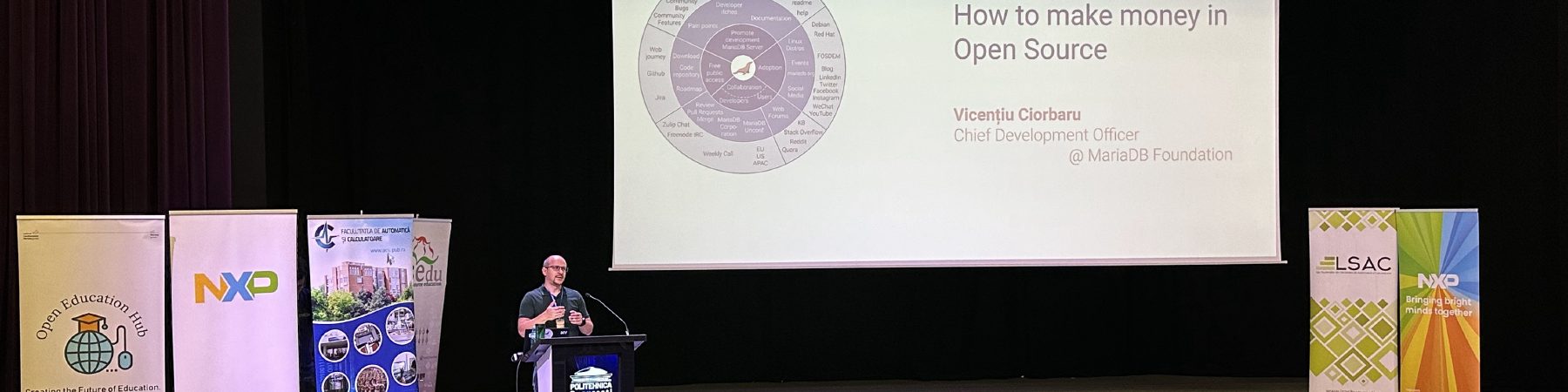
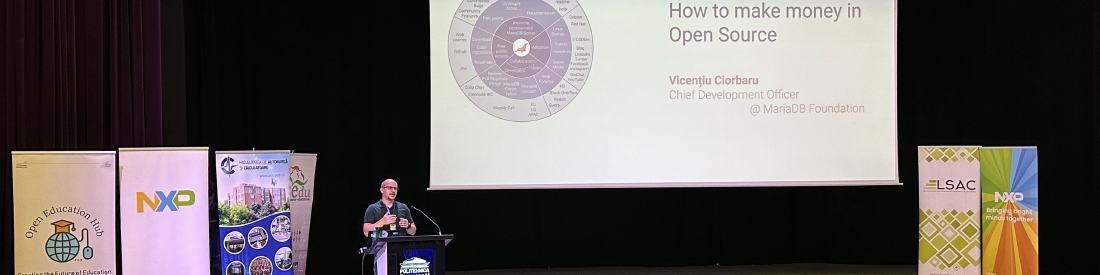
Talk How to Make Money in Open Source
Abstract & bio
Open Source and money sound like two conflicting topics. But the truth is that for an Open Source project to be truly succesful, it needs to be sustainable. There are many companies that have built a succesful business around an Open Source project. There are many approaches here and in this talk we will discuss the possible ones, what works and what (typically) doesn't.
Bio. Vicențiu is the Chief Development Officer at the MariaDB Foundation. Working on MariaDB Server, helping grow adoption and fostering open source collaboration.
Talk Kubesol, our Kubernetes distribution
Abstract & bio
Kubesol is a free and open source Kubernetes distribution, available on GitHub. I will present how and why it was started, how does it compare with other Kubernetes installers, how can you use it and how can you contribute to it.
Bio. Head of cloud and Infrastructure @ eSolutions.ro. 25+ years experience with Linux, Cloud, Kubernetes. CKA.
https://github.com/eSolutionsTech/kubesol
Workshop How to install stuff in Kubernetes
Abstract & bio
Running Kubernetes on your laptop: free and open source Rancher Desktop - Windows/Linux/MacOS.
Bio. Head of cloud and Infrastructure @ eSolutions.ro. 25+ years experience with Linux, Cloud, Kubernetes. CKA.
https://github.com/viorel-anghel/kubernetes-workshop-omniopencon-2024
Talk Solving Closed Source Issues Through Open Source for Selfish Reasons
Abstract & bio
This presentation explores how to identify and address performance issues in SQL Server using open-source tools like SQL Server First Responder Toolkit along with how and why PSBlitz was built on top of it, initially as a learning experience which later turned into a way to give back to the Data Platform community.
Bio. I've been working with SQL Server for the past 12+ years focusing on query performance, database security, and automation, with the bulk of my experience being gained while working with large production environments. I'm a Data Platform MCSE, as well as an OSCP and PNPT, with a passion for InfoSec and PowerShell. In my spare time I work on PSBlitz and post on my blog.
 Georgiana DolocanJupyterHub / 2i2c
 Mihai MașalaUPB/ILDS
 Dan TudoseACS (UPB)
 Bogdan PopaCongame
 Anca AlexandruUniversitatea "Dunărea de Jos" din Galați / dexonline.ro
 Radu Borzadexonline.ro
 Andreea DuțulescuACS (UPB)
 Mircea AntonRaiffeisen Bank Romania
 Viorel AngheleSolutions
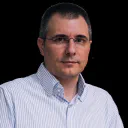 Adrian DușaUB, RODA
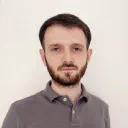 Sorin StănculeanuMultiversX
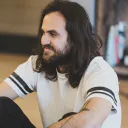 Răzvan NițuDLang
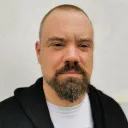 Rüdiger KlaehnIroh
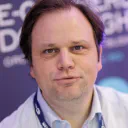 Bogdan ManoleaApTI
 Alexandru "Sopy" SoponarLLVM Foundation
 Iulian PașcalăuMultiversX
 Radu Mariașrencfs
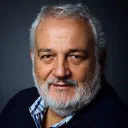 Italo VignoliThe Document Foundation
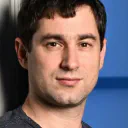 Alexandru RadoviciOxidOS / TockOS
 Alina MierlușUniversitad Autonoma de Barcelona
 Vlad DrumeaWolters Kluwer
 Bogdan IancuOpenSIPS
 Daniel GafniDagster Labs
 Sergiu WeiszOpen Education Hub
 Gabriel Masei1&1 Internet Development
 Răzvan DeaconescuUnikraft
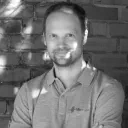 Thorsten Behrensallotropia